
Sarah
Absalom’s whole mess had just settled down, and King David finally made it back to Jerusalem.
You’d think things would finally calm down, and everybody could get back to doing what they were supposed to do.
But guess what?
Here we go again.
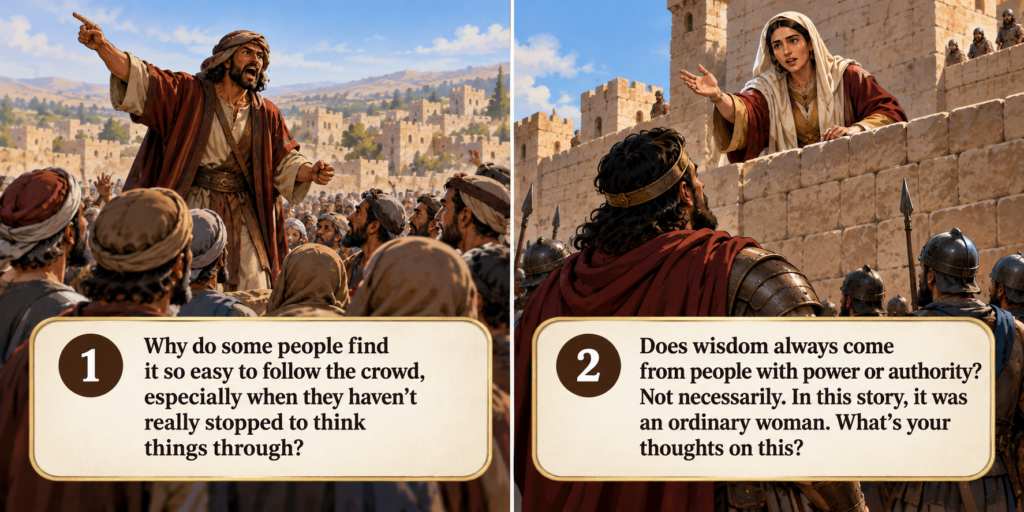
This time, a man named Sheba showed up and started stirring things up.
Sheba was a Benjamite, the son of Bichri.
As soon as he saw David had returned, he started causing trouble:
“What do we have to do with David?
We have no share in Jesse’s son!
Israelites, everybody go home!”
And believe it or not, people actually listened to him.
A lot of the Israelites left David and followed Sheba.
Seriously? Things had barely settled down, and now they were splitting up again.
But the men of Judah didn’t follow him.
They stayed close to King David and escorted him all the way from the Jordan River back to Jerusalem.
After David returned to Jerusalem, he still had plenty to deal with.
The ten concubines he had left behind to take care of the palace had been taken by Absalom. So David provided for them and kept them under protection, but he no longer had relations with them.
Then David called Amasa.
David said to him:
“Go quickly and gather the men of Judah.
Bring them back here within three days, and you come back here too.”
So Amasa went.
But there was a problem—
He took too long.
Three days passed, and he still hadn’t returned.
David realized he couldn’t wait any longer.
So he said to Abishai:
“Sheba is going to be more dangerous than Absalom.
Take my men and go after him.
We can’t let him get into a fortified city. If he gets in there, it’ll be much harder to catch him.”
So Abishai and the army went after Sheba.
And this is where Joab came along too.
They met Amasa near Gibeon.
Joab walked up to him, acting all friendly:
“Hey, brother! How are you?”
He looked like an old friend who hadn’t seen him in years.
Amasa wasn’t suspicious at all.
But who would have thought?
Joab was definitely not someone you wanted to mess around with.
While pretending to greet Amasa, Joab grabbed him by the beard as if he were going to kiss him.
Then he struck him with his sword.
Amasa fell dead.
And just like that, Joab continued leading the army after Sheba.
One of Joab’s young men saw that everyone was stopping to look at Amasa’s body, so he shouted:
“Whoever supports Joab, and whoever is loyal to David, follow Joab!”
People saw Amasa lying in the road and didn’t want to stop any longer.
The young man moved Amasa’s body off the main road and covered him with a garment.
Then everyone continued after Sheba.
Sheba ran through the tribes of Israel.
Eventually, he came to a city called Abel Beth Maakah.
He probably thought:
“This place looks safe. I’ll hide here.”
But then Joab and his army showed up.
And when they arrived—
Yep. They surrounded the city.
Joab’s army began building siege works against the city.
The city wall was about to collapse.
People inside the city were probably thinking:
“Okay… what are we supposed to do now?”
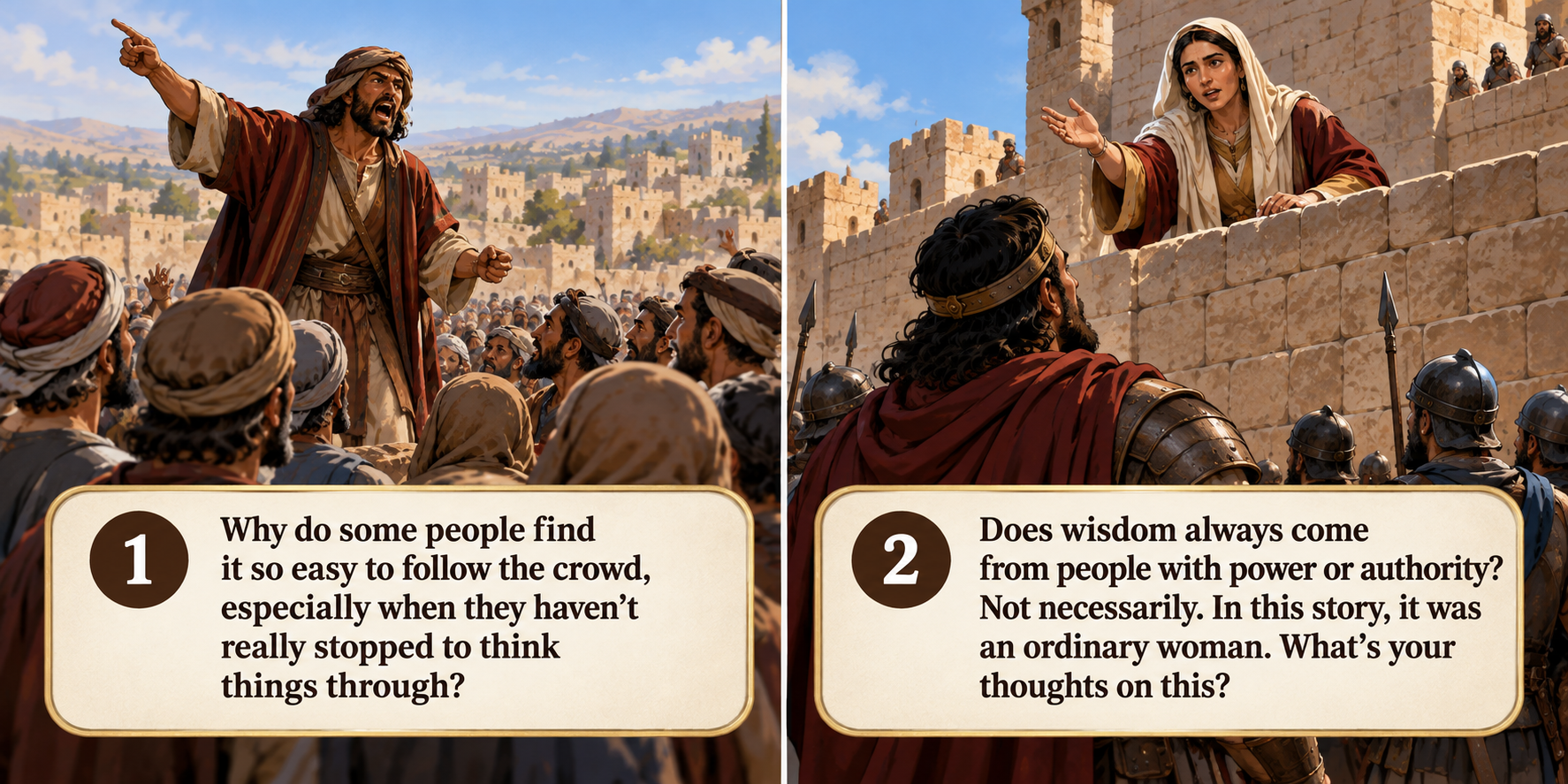
And then a woman stepped forward.
This woman was something else.
She saw what was happening, but she didn’t panic.
She didn’t start screaming.
She went straight to the city wall and called out to Joab:
“Hey, Joab!
Come over here. I need to talk to you!”
Joab came over.
The woman asked:
“Are you Joab?”
He said:
“I am.”
She said:
“Listen to what your servant has to say.”
Joab replied:
“I’m listening.”
Then the woman asked:
“Why are you trying to destroy our city?
We are a peaceful and faithful city in Israel.
Why would you destroy what belongs to the Lord?”
That was a pretty good question.
Joab didn’t argue with her.
He explained:
“I’m not trying to destroy your whole city.
We’re only looking for one man.
His name is Sheba, son of Bichri.
He has rebelled against King David.
If you hand him over to us, we’ll leave the city.”
The woman thought about it and basically said:
“Oh…
So that’s all you want?”
Then she went back into the city and talked to the people.
Using her wisdom, she convinced them what needed to be done.
The people agreed:
“We’re not going to let one man’s rebellion destroy the whole city.”
And then—
Chop!
Sheba’s head was cut off and thrown over the wall to Joab.
Joab looked at it and basically said:
“Alright. Problem solved.”
He blew the trumpet.
The army left.
And the people of the city were saved.
Joab and his army returned to Jerusalem and reported to King David.
Joab continued as commander of Israel’s army.
The other officials also continued in their positions.
And for the moment, things were back in order.
But when we look at this story more closely, there are some important questions we can ask ourselves.
Let’s Think About It
1. Why do some people find it so easy to follow the crowd?
Especially when they haven’t really stopped to think things through?
Sheba only had to say a few words, and many Israelites followed him.
Sometimes people hear something that sounds convincing, get caught up in the emotions of the moment, and simply go along with everyone else.
Have you ever followed the crowd before, only to realize later that you hadn’t really thought about what you were doing?
2. Does wisdom always come from people with power or authority?
Not necessarily.
Sometimes the wisest person in the room is the person nobody expected.
In this story, it was an unnamed woman.
She wasn’t a king.
She wasn’t a military commander.
She didn’t have an army.
She was simply a woman living in the city.
But when everyone else was facing fear and confusion, she stepped forward with wisdom and courage.
Who would have thought that this woman would be the one who helped solve the crisis and save the entire city?
Her wisdom prevented the whole city from being destroyed because of one man’s rebellion.
Maybe there’s a lesson here for us:
Never underestimate the quiet, ordinary, or overlooked people around you.
God can use someone who seems insignificant in the eyes of the world to make an enormous difference.
So here’s something worth thinking about:
Who are the people around you that others may overlook—but who might actually have wisdom, courage, and something important to teach us?