
Sarah
(2 Samuel 8):
This happened after David became king of Israel.
By this time, David was already very powerful. When the nations around him saw this, they thought: “Oh man, this David is not someone to mess with!”
But David wanted to prevent trouble before it happened. He defeated the enemies around Israel who had continued to threaten them, one by one.
First, David led his men to deal with the Philistines. After this battle, the Philistines were completely subdued by David, and he even took their capital.
Next, he went to fight the Moabites.
The Moabites could not hold out either. In the end, they had no choice but to submit to David and pay tribute to him. It was basically:
“Alright, alright, King David, you win. We surrender. From now on, we’ll give you what we owe.”
Then David faced an even stronger opponent—the king of Zobah, Hadadezer.
Hadadezer had quite a large army under his command, with chariots, horsemen, and foot soldiers. He was probably thinking:
“David? I want to see what you’re really made of!”
But when the battle was over, David completely stunned him.
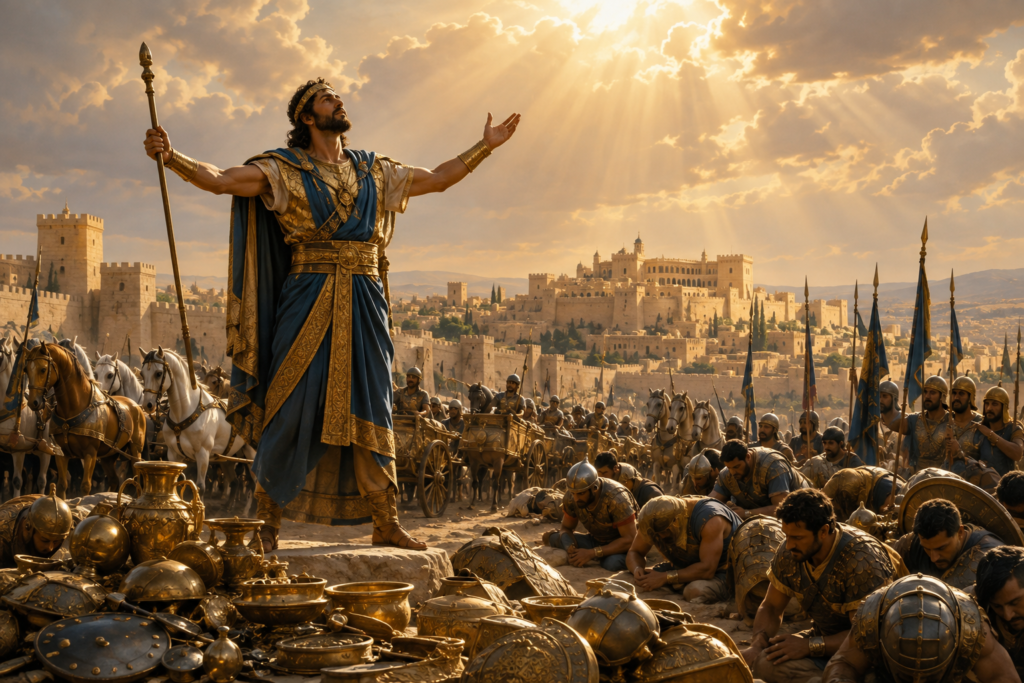
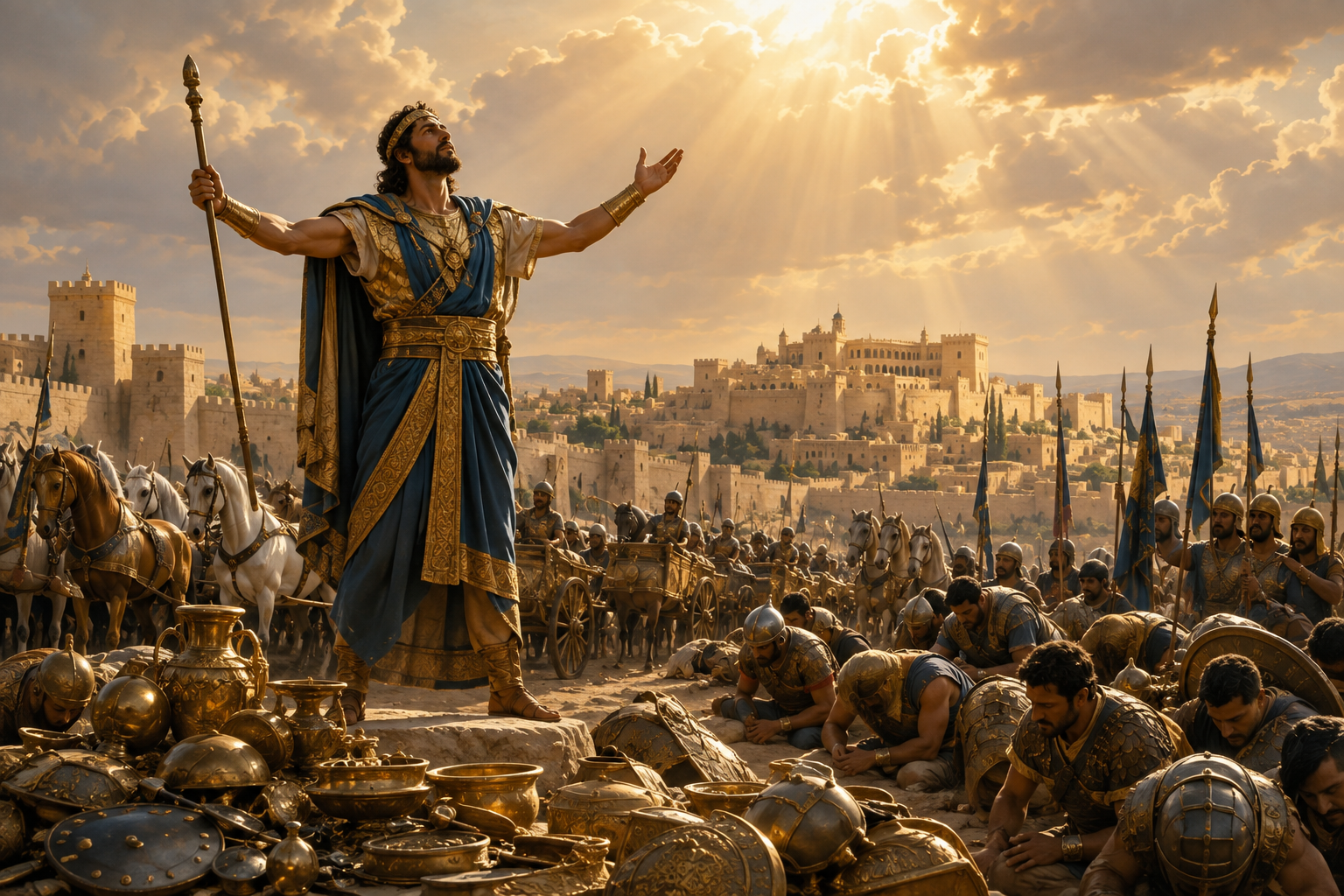
David captured more than a thousand chariots, seven hundred horsemen, and twenty thousand foot soldiers from him.
But David was also pretty interesting. He did not keep all the chariots. Instead, he cut the horses used to pull the chariots, keeping only enough for one hundred chariots.
Don’t think that David was so good at war because he relied on equipment.
Because what truly allowed him to keep winning was this sentence repeatedly mentioned in the Bible:
“The LORD gave David victory wherever he went.”
That is the key to this whole story.
Later, the Arameans from Damascus came to help Hadadezer.
But after they arrived, they found:
“Huh? How come we still can’t beat him?”
David defeated them just the same, killing twenty-two thousand of them.
David then established garrisons in the territory of the Arameans, and the Arameans also submitted and began paying tribute to David.
At this point, the nations around him began to realize one by one:
“This David is no ordinary man. He has God backing him.”
There was also a king of Hamath named Toi.
When he heard that David had defeated Hadadezer, he was extremely happy.
Why?
Because Hadadezer had fought against him before. As the saying goes, the enemy of my enemy is my friend.
So Toi quickly sent his son Joram to meet David, and he brought a large amount of gold, silver, and bronze.
Basically, he was saying:
“King David, my brother, congratulations! You fought a great battle! Keep these things, and let’s live in peace from now on.”
After David received these things, he did not say:
“Oh my goodness, so many good things! They’re all mine now!”
No.
David set these things apart as holy and dedicated them to the LORD.
In other words:
“This isn’t because I’m so great. These victories were given to me by God. What belongs to God must be given to God.”
Later, David also defeated the Edomites in the Valley of Salt and established garrisons throughout Edom.
The Edomites also submitted.
Look at what happened all around him—the Philistines, Moabites, Arameans, Edomites, and other hostile nations, one after another, were subdued by David.
So the Bible emphasizes again:
“The LORD gave David victory wherever he went.”
But if you think that after David became powerful, he only knew how to fight, then you would be mistaken.
David eventually became the king of all Israel.
And the Bible specifically says something very important:
“David administered justice and righteousness for all his people.”
What does that mean?
It means David not only knew how to fight, but he also had to know how to govern the nation.
He could not say:
“I’m the king now. Whatever I say goes!”
Instead, he had to act fairly and govern the people according to righteousness.
So this chapter is not just about David “winning battles.”
What it really wants to tell us is:
David had ability, but he knew where his ability came from; David had the spoils of war, but he knew who deserved the glory; David had the throne, but he knew how to treat the people fairly.
Finally, the Bible lists the important people who served under David one by one:
Joab was the commander of the army;
Jehoshaphat was the recorder;
Zadok and Ahimelech served as priests;
Seraiah was the secretary;
Benaiah commanded the Kerethites and Pelethites;
David’s sons also served as leaders.
This shows that David’s kingdom was gradually becoming established.
But the truly great thing was not that David himself thought:
“I, David, am really something!”
Rather, he knew:
“It’s not because I’m so capable. It is because the LORD is with me.”