
Sarah
This whole mess starts with Absalom.
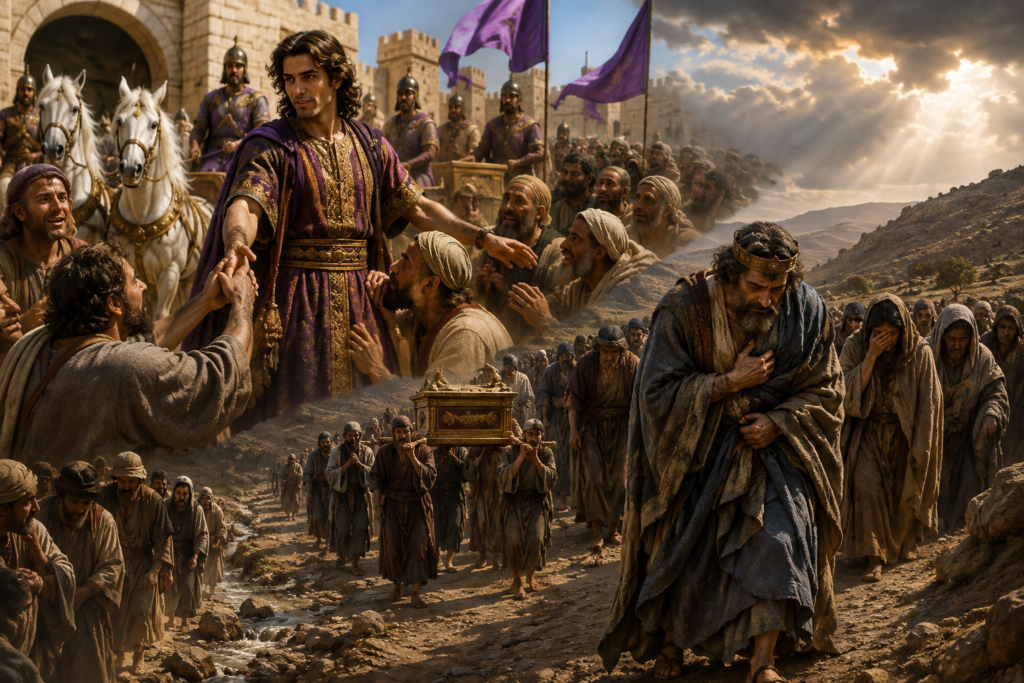
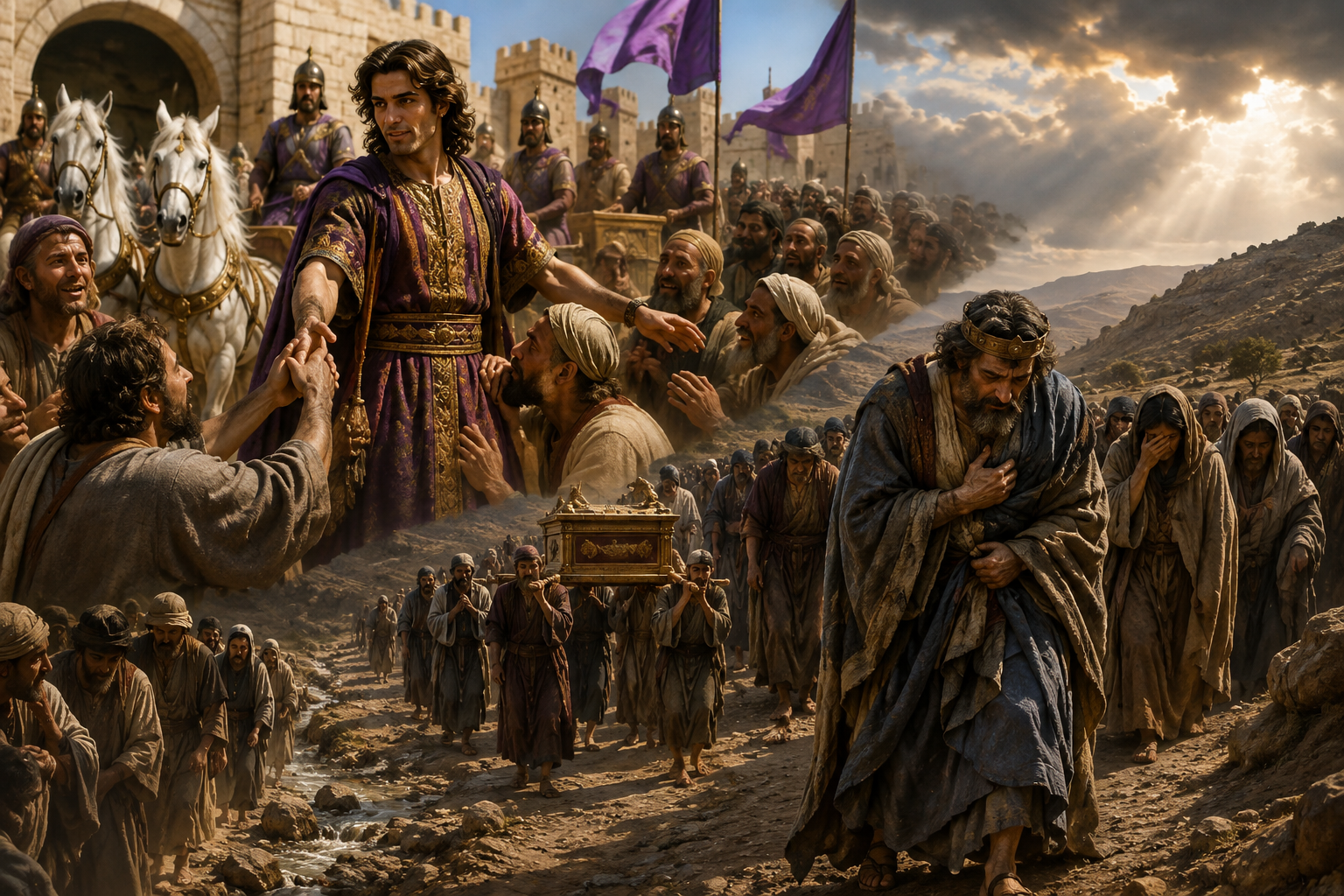
This Absalom guy had quite a few tricks up his sleeve. First, he got himself a chariot and horses, and had fifty men running ahead of him. He sure knew how to put on a show.
Then, every morning, he got up early and went to stand by the city gate.
Back then, if people had a dispute or felt they had been wronged, they would go to King David to have the matter judged.
Whenever Absalom saw someone coming, he would walk right up and start talking:
“Hey, brother, where are you from?”
The man would answer:
“I’m from one of the tribes of Israel.”
And Absalom would immediately say:
“Well, you’ve got a good case! I can see that right away. Too bad the king hasn’t appointed anyone to hear your case.”
Now that’s a pretty slick thing to say.
Then he’d go on:
“If only I were appointed judge in this land! Then anyone with a dispute or complaint could come to me, and I’d make sure you got justice!”
When someone came to bow to him, Absalom wouldn’t even let them. He’d grab them, pull them up, and give them a kiss.
Talk about looking like a man of the people!
After a while, quite a few people in Israel were won over by him.
On the outside, Absalom looked like he really cared about the people. But deep down, he was already thinking:
“Maybe I can get that throne for myself.”
Later, Absalom said to King David:
“Father, I’d like to go to Hebron and fulfill a vow I made to the LORD. When I was living in Geshur in Aram, I made a vow that if the LORD brought me safely back to Jerusalem, I would serve Him.”
King David said:
“Sure. Go in peace.”
But that wasn’t what Absalom had in mind at all.
When Absalom got to Hebron, he immediately sent messengers throughout Israel with this message:
“As soon as you hear the trumpet, shout, ‘Absalom is king in Hebron!’”
Well, that changed everything.
He also took two hundred men with him from Jerusalem.
They were honest people who had no idea what Absalom was really planning. They simply went along, not knowing what was coming.
To make matters worse, Ahithophel, one of David’s trusted advisers, joined Absalom.
That made Absalom’s movement grow fast.
More and more people started following him.
Soon, someone came running to tell David:
“My king, this is bad! The hearts of the people of Israel have turned to Absalom!”
David’s heart sank when he heard it.
He knew this was no joke.
So he quickly told his servants:
“We’d better get out of here! If Absalom attacks, none of us will escape. And it won’t just be me—the people in Jerusalem could be killed too.”
His servants answered:
“Whatever you decide, my lord the king, your servants will follow.”
So David left Jerusalem with his household.
The people went with him too.
It was a heartbreaking sight.
The king himself was being driven out of his palace by his own son, forced to flee for his life.
Then there was a man named Ittai, who had come from Gath.
David said to him:
“Brother, don’t come with me and suffer because of this. You just arrived. Go back. I don’t even know where I’m going next. Why should you wander around with me?”
David even blessed him:
“May the LORD show you steadfast love and faithfulness.”
But Ittai answered:
“As surely as the LORD lives, and as surely as my lord the king lives, wherever my lord the king may be, whether for death or for life, your servant will be there!”
That’s about as loyal as it gets.
In other words:
“Don’t try to talk me out of it. Whatever happens, I’m going with you.”
David saw that Ittai had made up his mind, so he stopped arguing.
So Ittai and his men went with David.
Along the way, the people cried, and David cried too.
They crossed the Kidron Valley and headed toward the wilderness.
Then Zadok the priest arrived.
He had brought the ark of God with him.
But David quickly said:
“Take the ark of God back to Jerusalem.”
David understood something important:
Whether he returned to Jerusalem would not be decided by whether the ark followed him. It would be decided by whether the LORD chose to bring him back.
He said:
“If I find favor in the LORD’s sight, He will bring me back so I can see the ark and His dwelling place again.
But if He says, ‘I am not pleased with you,’ then I accept it.
Here I am. Let Him do to me whatever seems good to Him.”
Even though David was in a terrible situation, he understood something important:
You can’t hold on to a throne just because you want to. In the end, God’s will is what matters.
Later, David covered his head, went barefoot, and walked along crying.
The people with him covered their heads and cried too.
There wasn’t much royal dignity left in that scene.
And then came another piece of bad news:
“My king, Ahithophel has joined Absalom too!”
David knew that made things even more serious.
Ahithophel was known for giving very wise counsel.
So David prayed directly to God:
“LORD, please turn Ahithophel’s counsel into foolishness!”
Just then, David’s friend Hushai arrived.
His clothes were torn and his head was covered with dust. He had come to mourn and suffer alongside David.
But David told him:
“Don’t come with me. Go back to Jerusalem.”
Hushai was probably thinking:
“What? Go back?”
David said:
“Yes. Go back.”
“You can pretend to serve Absalom and tell him, ‘My king, I will be your servant. Just as I served your father, I will now serve you.’”
“That way, you can help me defeat Ahithophel’s plans from inside.”
Basically, the plan was:
“Don’t run away with me. Go back and work undercover.”
So Hushai went back into Jerusalem.
And Absalom entered Jerusalem too.
And that’s how it happened:
Absalom, the son, took Jerusalem, while David, his father and king, was forced to flee into the wilderness.
The battle for the throne had officially begun.
David looked like he was losing ground fast.
But he did not give up on God.
He knew:
People can scheme, people can rebel, and people can fight for a throne—but in the end, the LORD is still the One who is truly in control.
That is the story of 2 Samuel 15.
A son betrayed his own father for the throne;
and a father, while fleeing for his life, placed himself back into God’s hands.